Chambert's Second Digression on Combat Drones
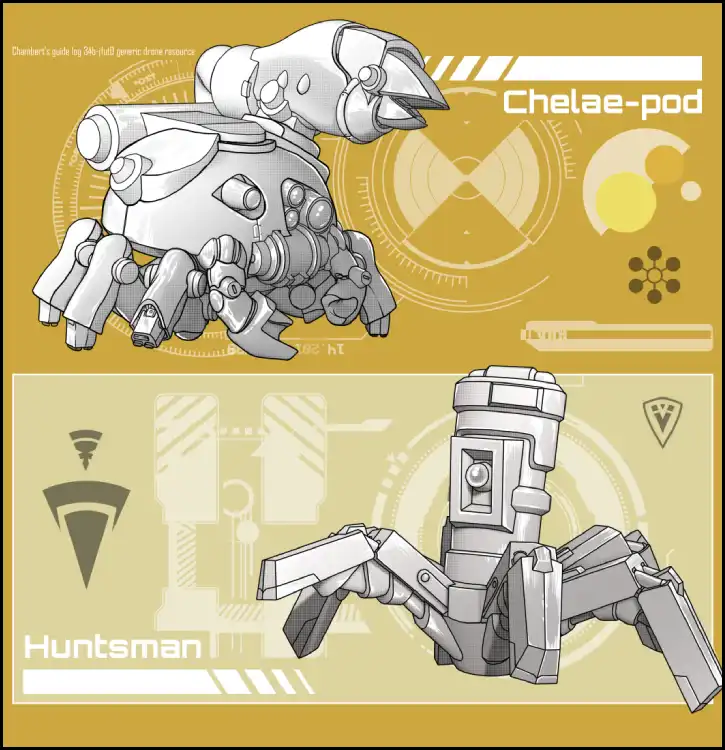
In the aftermath of my first digression into the topic of combat drones, a rather stimulating discursive thread emerged about the design histories they seemingly all shared. The base observation and theory is simple enough: all extant combat drones in use by Pact militants and GuardCorps forces owe their original specifications to a civilian design.
Of course, the militarization of civilian zeoform designs, with both its successes and failures for the Pact and GuardCorps respectively, is well documented. Even so, to find it so seemingly universal an axiom in the realm of combat drone design has proved to be a stimulating topic, and in that spirit I have two additional commentaries to tender in the debate.
Pact: The Chelae-Pod Drone
The combat drone known as the Chelae-Pod to the Pact is derived from a civilian type that is rarely seen by most, even by those that travel extensively on ships or to stations and habitats operated by People's Galactic. In its civilian guise the Chelae-Pod is a salvage and engineering drone optimized to continue to function in the most extreme environments imaginable: high gravity, temperature ranges wide enough they would melt or freeze non-specialized materials in moments, crushing pressures, and scales of radiation exposure sufficient to make them a disposal hazard after completing their task.
No matter in the humanverse can claim to be indestructible, but Chelae-Pods make a remarkably good showing considering their relatively cheap construction. As most civilian-use Chelae-Pods are to be found working in helium lakes, fusion reactors, or ultra-high gravity, they make a rare sight, and are not exactly grandiose in appearance either—each one is a fattened disk with stubby manipulators seemingly spaced at random around its circumference.
The method a Chelae-Pod uses to achieve its remarkable durability is embodied in its simple construction. Two solid plates are etched on their inner faces with graphene circuitry less than a micron thick. The two are sealed together with limb actuator rods arrayed along the rim, connecting in the middle to a central control hub. Basic energy is supplied by a wafer-thin integral charge pack at the hub. The charge pack harvests energy from the environment via the actuator rods, the redistribution of internal waste heat forming a key part of the process. In practice, this means a Chelae-Pod can operate within its targeted environmental envelopes for unlimited periods, while in less hostile climes an auxiliary power source is required for more than a few hours of operation.
This simple civilian design has much to recommend it as a combat drone, to the extent that it is probably more commonly seen in that role. It is low-maintenance, with a small target profile and exemplary durability. These qualities are rather undercut by its somewhat limited mobility—Chelae-Pods are relentless but not quick. On arrival, however, they can pose a considerable threat, as even the most basic Chelae-Pod has actuators equipped with cutting saws or torches and grippers strong enough to bend hull plates. Pact forces commonly field a variant “gun-crab” configuration of Chelae-Pod that mounts a ranged weapon on the pod's upper carapace.

GuardCorps: The I-102 Huntsman Scout Drone
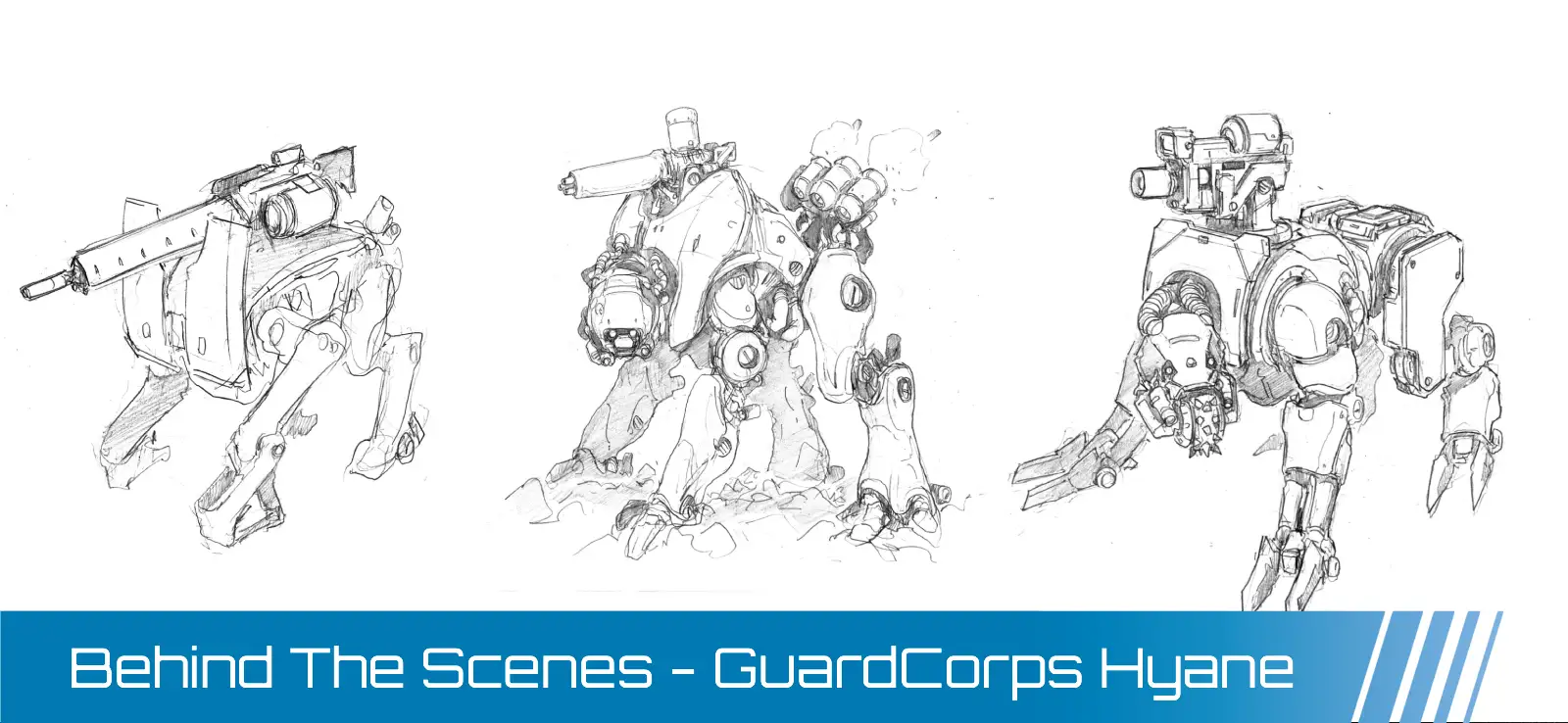
The mirroring GuardCorps equivalent to Pact combat drones like the Bokugyo and the Chelae-Pod has to be Interhelios’ I-102 Huntsman scout drone. While the GuardCorps’ Hyane and Steelback underwent substantial redesigns from their original civilian chassis in order to fit military specifications, the I-102 is barely changed aside from its designation. The original drone is a surveillance probe marketed by Garamon Conglomerate under the “Pioneer 7X” title. The Pioneer series was designed to be released from orbit in large numbers in a network to complete comprehensive atmospheric, topographic, and mineral surveys of planetary bodies.
The Pioneer features a cylindrical body containing a one-use braking thruster plus sensory equipment. Once landed, a small set of grippers on one end of the cylinder supplies the motive power necessary for basic ambulatory progress as required by the probe to complete its survey. A small fissile energy source supplies the probe's immediate needs, but once the energy source fails, there is no capacity for replacement. In all regards, the Pioneer is designed as a piece of expendable equipment, and is not intended to be retrieved after use.
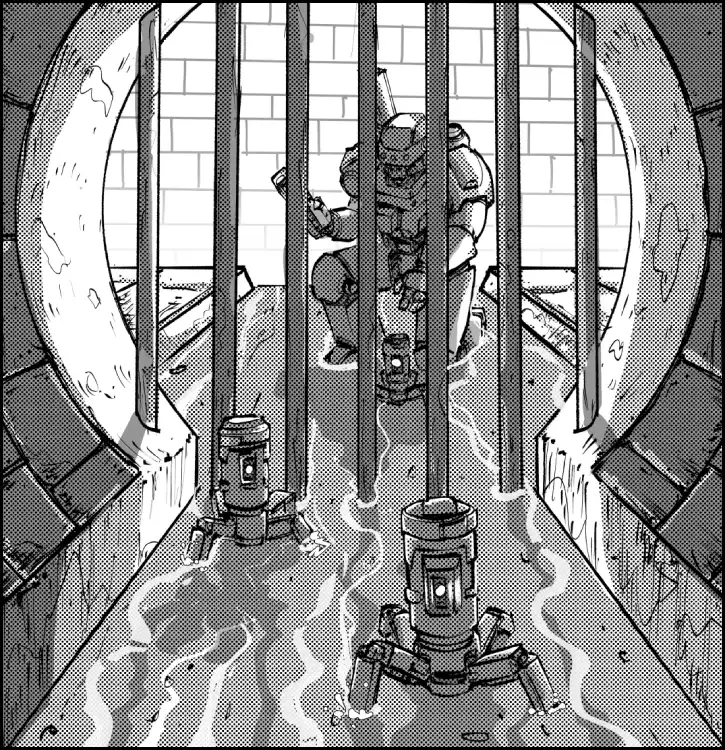
The Huntsman militarized GuardCorps model has a basic firmware upgrade with combat protocols and a handful of alterations to the power source, braking charge, and actuator assembly to provide a small suite of improvised close-ranged attack options. A stealth coating is commonly applied, reducing the already limited emissions of the drone still further. Small size and lack of detectability are the only protection a Huntsman can rely on; like the Pact Bokugyo, they lack any armor or defenses. They are employed mostly for reconnaissance in passive mode, but can be pressed into action as mobile attackers if need be. Most of all, the Huntsman is cheap and lightweight—indeed, it's not uncommon for Drone Ops to carry several Huntsman units in a backpack dispenser until deployment is desired.
As an enlightened reader has no doubt grasped by now, the parallel I am drawing between these two combat drones is simple. Not only are they civilian designs at heart, but they are cheap to build and simple enough that they can be deployed in large numbers. It would seem that the lesson to draw is that drones are most successful when they are designed as essentially expendable equipment with limited functionality that can be adapted to a combat role.
More sophisticated drones perhaps fall into the trap of attempting to build mechanical soldiers. The seductive qualities of absolute obedience and designs dedicated to excelling within a limited role has been seen before with attempts to create zeoforms of a similar nature. This process always appears to fall short of expectations due to the lack of a human element that can actively learn from experience and strategize based on those experiences. This alone reinforces my contention that all ground forces must ultimately pale in comparison to the balance of desirable aspects consistently demonstrated in competent combat zeoform design.
One of the most respected analysts, known both for highly detailed breakdowns and post-engagement evaluation as well as more informal “pop” texts is “Drew Chambert” (a nom de plume). Little is known about this writer except it is evident they are or have been a zeo designer, possibly even a pilot at some point, and have some quite deep connections into both Pact and GuardCorps operations. Their writings and audiocasts are available across all one hundred heliospheres to a greater or lesser extent.




















.webp)
.webp)