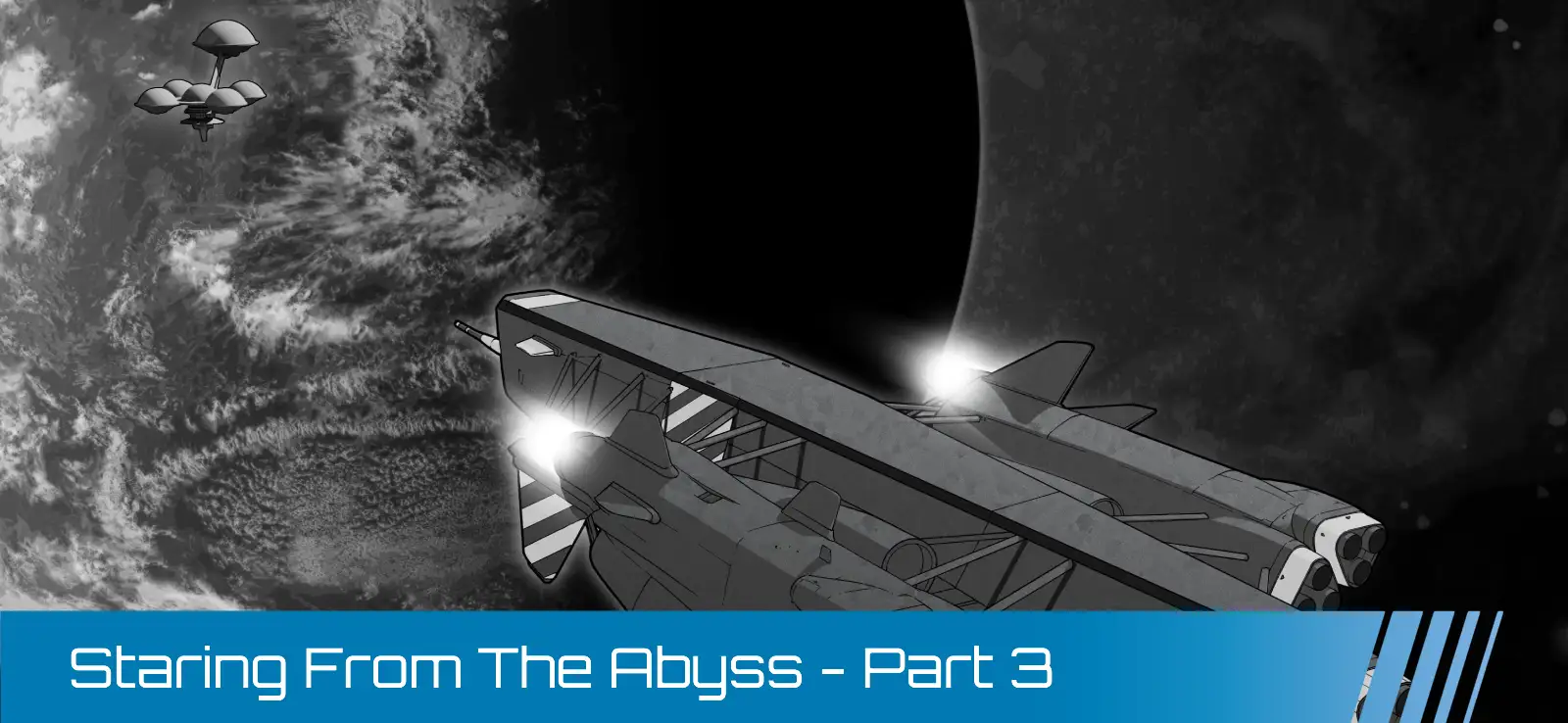
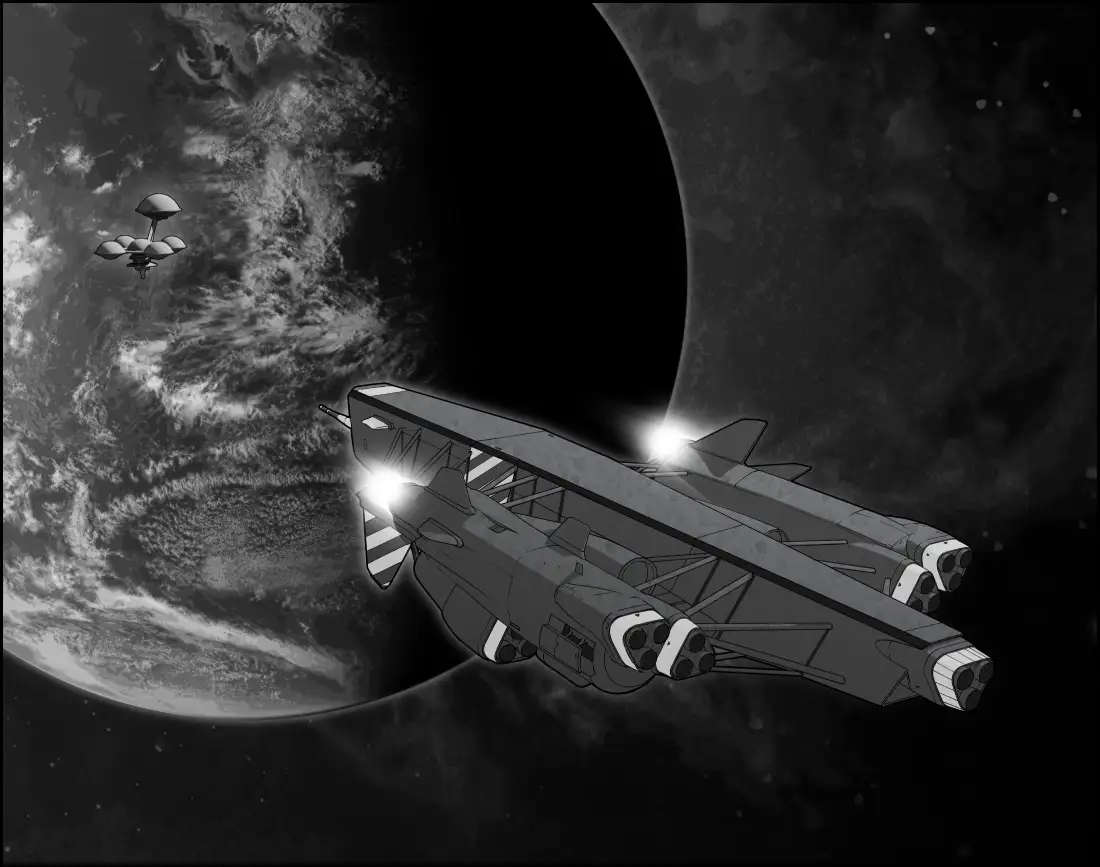
Staring From The Abyss
Marius ran to the vent.
“Can,” “We,” “Come,” together, “Too?”
“No.” Marius pointed at the bulging door. “You have a visitor.”
The Honeys turned, smiling.
“We,” “Shall,” Welcome,” together, “Them.”
Marius slid down the vent after Halem. The man’s feet were just ahead, lit by the glow from Marius’s bioluminescent hand.
Halem’s voice echoed back down the vent to him. “Which way?”
Marius paused. His feeds were still blanked, but he had his memory; he located the bridge in the schematic that he had implanted and found the circulation vent system.
“Right.”
Halem twisted around the corner, but as Marius was following him, he felt the air behind him expand and contract.
He tensed, waiting for the fire flash, but none came, only the sound of supersteel, breaking.
The bridge had been breached. Whoever was after Halem had peeled open the most secure space in the Abyss Station as if it was a food can.
That at least answered one question. Only a zeo could do that. But zeos were big: no way one could fit in the air vent system. It would have to try to track them from outside.
Scrabbling after Halem, Marius directed him on. “Left. Right. Straight. Up.”
The last was difficult, but they only had to climb a body length and he pushed Halem up to the junction, then chimneyed up himself.
Reaching a T-junction, Marius told Halem to take the left and wait, then took the lead position in the right-hand vent.
“Follow me.”
“Where are we going?”
“Your cutter. I’m getting you out of here.”
But as he spoke, from behind, there came a sizzle-hiss. Marius craned his neck and saw a stream of light cutting through the vent behind them.
“Photon cutter,” he hissed. “Quick.”
Scrabbling on hands and knees and toes, the two men slid through the vent system, Marius trying to keep the implant schematic in his mind as he checked through passing outlets to verify their location.
“H-how much further?” Halem panted from behind him.
“Not far. Try to keep the noise down.”
They were trying to track them, but at least the masker that Marius had implanted was not dependent on his external feeds but ran independently. The fact that they had got this far with only one near miss told that it was working.
Marius pushed through a one-way valve and looked ahead. There was light coming from an outlet vent. He checked the schematic. They should be at the station’s internal hangar. With the light from outside, he switched off his own bioluminescence, then crawled up to the grate and peered through.
Clear.
If he had been commanding the snatch team coming into the station, he would have posted a sentry in the hangar to guard against escapes. But he didn’t know how many zeos were after them. If just one—and one was enough to do what had been done—then obviously it could not put itself on guard. Even a three-zeo team could not afford to leave one zeo against the chance that they missed their quarry.
The mask was working. Marius silently thanked the extremely deep pockets of the Halem clan family that had paid for his masking system and worked on the securing nuts of the grille, working as quickly and quietly as he could.
Halem crawled up behind him. For once, Warq kept his mouth shut and waited.
The grille came free. Marius carefully moved it out of the way and looked around the hangar.
Clear.
The Halem cutter was at the far side, silhouetted against the black of space and the shimmer of the ion field that held the void at bay. Between them and the cutter were the various maintenance and research vessels that allowed the station to carry out its tasks: shuttles, sliprunners, atmosphere flitters, and even a hauler.
Final check.
The hangar’s internal port. To guard against any breakdown of the ion field, the hangar could only be accessed from within the station through the airlock. And it was closed but not cycling. No one was coming through after them.
For a moment, the thought passed through Marius’s mind: they were actually going to make it.
Leave that for later, when they were on burn away from the station. Now it was time to get to the cutter.
He twisted his neck to whisper back to Halem.
“When we go through, head straight to the cutter. Get in her and fire the systems. I will release the clamps. Then we go.”
“What about the ion field?”
“We go straight through it. The atmosphere is ionised, the cutter isn’t.”
“Right.”
Marius saw how pale Halem’s face was. “Don’t stop for anything.”
A weak smile. “Trust me, I won’t.”
“On my count. One. Two. Three.”
On three, Marius pushed out of the vent, rolled to his feet, scanned—clear—and pulled Halem up onto his feet as he dropped out of the vent after him.
“Go, go, go!”
Halem set off running across the hangar, Marius running cover behind and beside him, culverin drawn.
Then everything happened very quickly.
The ion field flared.
Turning toward the flare, Marius saw movement. Movement so fast that it blurred across his vision, coming toward them.
Without conscious thought, he thumb-tapped the first joint of his index finger. His system flooded with neurotransmitters, accelerants, and pain inhibitors.
Time slowed down as his perceptions sped up by a magnitude.
And still the shape coming toward him smeared in his vision.
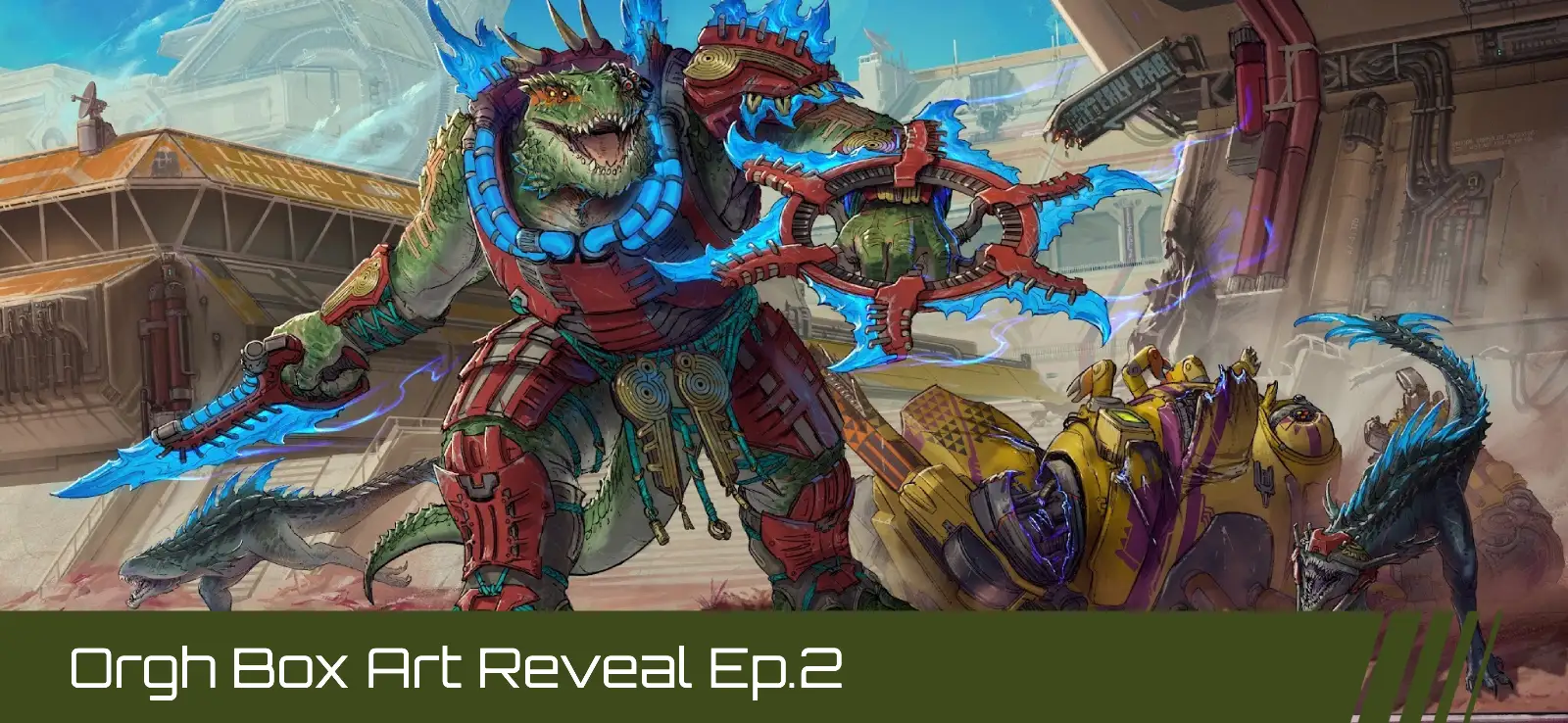
But it was big, about twice his height, its colors bleeding in his vision as it ran, leaving a trail of black and red weaving between the tethered ships, covering the distance from the ion field faster than he could follow.
Marius brought up the culverin and tried to lock it on the target, but it weaved in his sight, breaking left and right in random patterns that made it impossible to anticipate.
Closing in on them.
He could feel the supersteel plates beneath his feet vibrating from its approach.
This was what it was like to face a zeo.
The thought came fully formed so he had time to think it.
Then the zeo hit him.
Even with his system flooded with pain inhibitors and accelerants, it seemed as if a tsunami had flooded the hangar and sent him tumbling backward, limbs flailing, until he crashed into the side of a shuttle.
But this was where the combat stimms came into their own. Despite the shock, Marius did not lose consciousness. Propped against the shuttle, he raised the culverin and locked in on the zeoform, stooping over the body of Warq Halem.
But before he could trigger the culverin, the zeo turned its head toward him.
“Don’t,” it said.
Marius saw the meson beamer trained upon him. It had moved so fast he had not seen it lock on.
Sometimes, thought could be faster than a zeo. Marius saw the possible futures ahead of him, forking from his immediate choice. In one, he died in a fraction of a second and the zeo took Halem. In the other, he lived and the zeo took Halem.
He put down the culverin.
The zeo nodded. A moment of respect, from one warrior to another, before it began to bend down to pick up Halem.
But before it could do so, it went flying over the prone man, tumbling toward Marius.
Death was now coming to him. Marius threw himself out of the way as the zeo crashed into the shuttle where he had been sitting. The shuttle crumpled.
Marius looked to Halem.
There was another zeo standing over Halem now, blue and gold and crouched where the other zeo was tall.
It was just as well his system was fired with stimms. Marius was just about able to make out what happened next. Without them, it would have been nothing but blurred movements, over before he could perceive them.
The zeo beside him rose to its feet. Despite its machine nature, it moved like liquid.
The zeos faced each other, Halem face down on the hangar deck, trying not to move.
As one, each zeo put down the weapon it was carrying.
Marius understood. They had each come for Halem. Using their weapons risked killing the mission target.
Then, they moved.
Even with the stimms flooding his perceptive systems, Marius saw only blurs. A skimmer collapsed as one zeo was thrown through it. Another disintegrated when that same zeo ran through it after its foe.
The combat was pulling the zeos away from Halem. Marius saw him look up. He gestured to him, pointing toward the cutter, and Halem started frantically crawling toward it.
Marius checked the position of the zeos. They were moving faster than the sound of their battle, shifting around the hangar and using the craft in it for concealment and confusion.
He had to hope they were too occupied with each other to notice him. Getting to his feet, he started running toward the cutter, thanking the pain inhibitors as he went.
Halem was almost at the cutter.
The black-and-red zeo, moving so fast he did not even see its approach, scooped Halem up and away from the cutter and put him down in the center of the hangar, standing over him.
Marius stopped, helpless.
The blue-and-gold zeo faced its foe.
They both looked down at Halem.
Then slowly, deliberately, they stepped sideways.
In that pause, Marius could see damage on both zeos, but even as he watched, he saw the damage healing as the zeos’ nanorepair mechanisms crawled over the armor.
The clash was like thunder and lightning, like two storms fighting. And this time, there was no maneuvering. The zeos stood in front of each other, trading hits, and the sound was like the sound of a rainstorm, so frequent were the blows.
Marius realized his only hope to save Halem was if the zeos destroyed each other.
He touched the second joint of his index finger and felt the immediate down as the flow of stimms cut off. But he had allowed the pain inhibitors to continue. The down when they stopped was going to be…painful.
He saw Warq standing, watching the combat, as he was: spectators of their fate.
Then, the ion field flared, briefly, just enough to catch his eye because he was looking past the zeos toward it. Just a tiny flare. The sort of flare normal when an external ionized particle met it. The sort of flash the scientists in the station pored over with their particle detectors when studying the Brouwer point.
But then there was a man standing beside him.
Marius looked up at him. He was an ordinary man—military, for he was wearing a uniform, although its insignia were unknown to him. The officer, for he must be an officer, looked down at Marius. And winked.
Marius looked up.
The zeos fought on. But where before their fighting was faster than his eyes could see, now they moved as if in heavy water, and they were clothed in a yellow-gold glow that lit them alone.
The officer smiled.
“It’s so hard to talk with all that noise.”
“What have you done to them?”
“They are Looped away for a while. Until we leave.”
“We?”
“The invitation is mainly for Mr.Halem. But I had better take you along, too.”
“What if we refuse?”
The officer nodded toward the zeos. “Do you think you could?”
Marius shook his head.
“Then let’s go.”
The officer reached down and helped Marius to his feet.
“You do know that Warq’s family will pay any ransom you deliver to them?”
The officer smiled again.
“We’re not interested in Mr.Halem’s money. We’re interested in his ideas.”
Marius shook his head. “You mean his stupid theory that we’re all being kept prisoner in some sort of celestial prison?”
“There are people who would like to discuss it with Mr.Halem in more detail.” The officer gestured toward Warq. “Let’s go.”
“Where?”
The officer pointed toward the ion field. Outside, there was a ship unlike any Marius had ever seen before, for it seemed to slide away from his sight even as he looked at it.
“There.”
END
***
About:
Edoardo Albert is a British writer of Italian and Sri Lankan descent. He writes about Britain in the early medieval period (between the Romans leaving and the Normans arriving), the 40th millennium in the Warhammer universe, and lots of other things besides. He enjoys hearing from his readers via social media or directly through this website (you can find the contact form here).
Social Media:
Website: https://edoardoalbert.com/about/
Facebook: https://www.facebook.com/EdoardoAlbert.writer
Twitter: https://x.com/EdoardoAlbert



.webp)
.webp)